
.svg)
At the same time, many in the sector are urging the Government to move quickly to resolve genuine risks and uncertainty, particularly around capital gains tax reforms, that could potentially undermine the startup and scaleup ecosystem
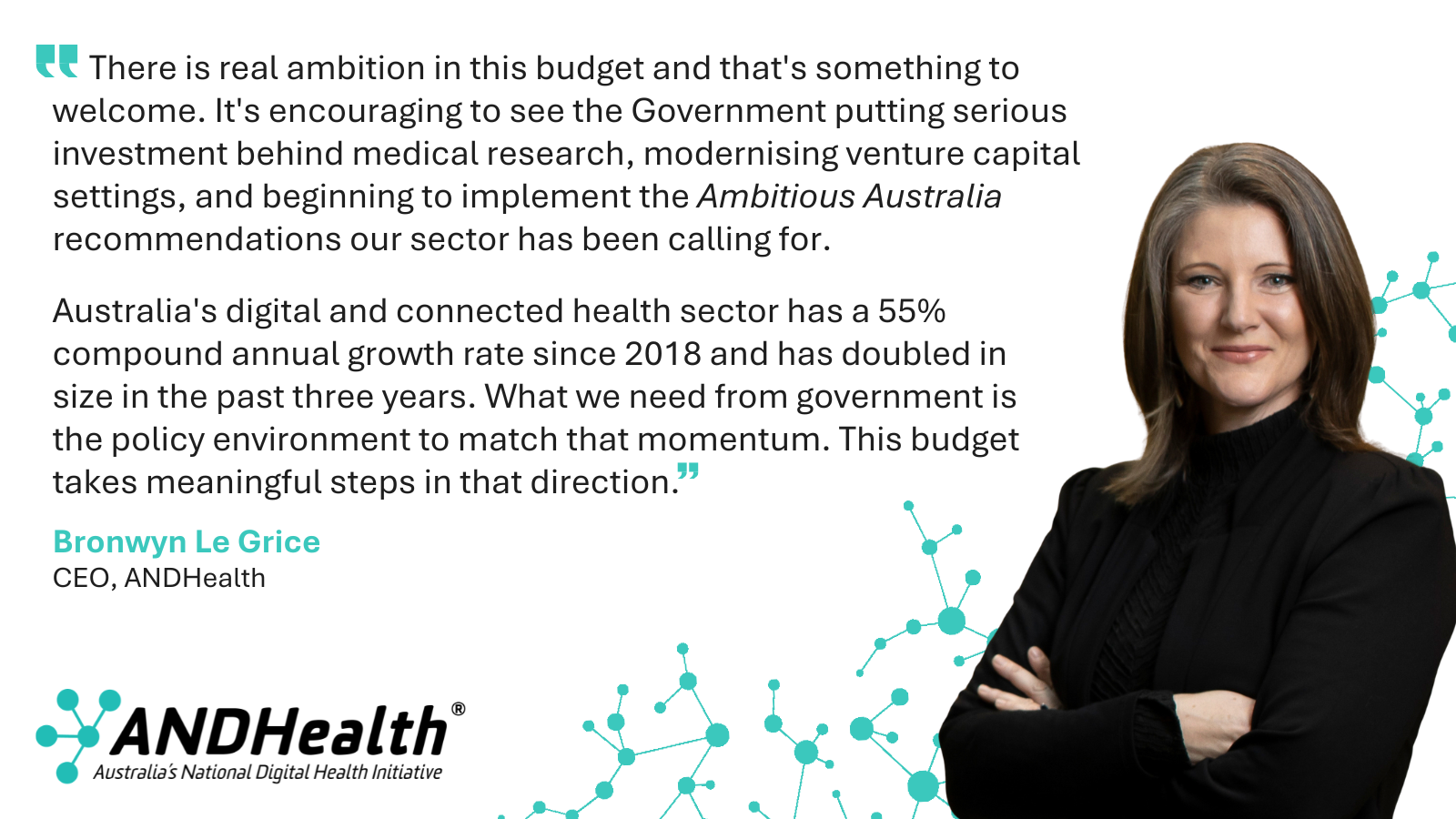
“There is real ambition in this budget and that's something to welcome. It's encouraging to see the Government putting serious investment behind medical research, modernising venture capital settings, and beginning to implement the Ambitious Australia recommendations our sector has been calling for,” said ANDHealth Chief Executive Bronwyn Le Grice.
“Australia's digital and connected health sector has a 55% compound annual growth rate since 2018 and has doubled in size in the past three years. What we need from government is the policy environment to match that momentum. This budget takes meaningful steps in that direction.”
But she also argued that we cannot gloss over the risk posed by the proposed capital gains tax changes.
“For the founders, early employees and investors who build Australia's health technology companies, often taking significant financial and career risk on the promise of long-term equity upside, these reforms as currently designed could fundamentally shift the calculus. We welcome the Treasurer's commitment to consult with the startup sector on CGT implementation, and we look forward to being at that table. The intention is right; the detail must follow. This is the moment to get it right.”
Where the Budget delivers
The 2026–27 Federal Budget delivers several measures that ANDHealth has long championed and that will meaningfully strengthen Australia's digital and connected health innovation ecosystem.
Medical Research Future Fund (MRFF) uplift
The Government's commitment to grow Medical Research Future Fund disbursements from $650 million in 2025–26, rising to $1 billion per year by 2030–31, is a landmark investment in Australia's health and medical research capacity. ANDHealth has consistently advocated for unlocking the full potential of the MRFF to support translation-focused research and the development of evidence-based digital and connected health technologies. This increased investment, if appropriately directed toward digital and connected health, could accelerate the development and commercialisation of new Australian health technologies.
R&D Tax Incentive (RDTI) reforms
The budget introduces a suite of RDTI changes that take effect from 1 July 2028, including:
• Increasing the refundable R&D tax offset threshold from $20 million to $50 million aggregated turnover – supporting the fast-growing startups and scaleups that make up ANDHealth's portfolio
• Increasing core R&D offset rates by 4.5 percentage points, providing approximately 25–50% stronger financial incentives for genuine experimental activity
• Reducing the R&D intensity threshold from 2% to 1.5%, enabling more firms undertaking substantial core R&D to access premium offset rates
• Raising the maximum RDTI expenditure cap from $150 million to $200 million, encouraging larger-scale R&D programs to remain onshore
These changes align with the spirit of the Ambitious Australia SERD Report, which ANDHealth welcomed and which recommended a modernised RDTI framework that better reflects how digital and connected health and software technologies are built and commercialised.
National Resilience and Science Council
The establishment of the National Resilience and Science Council is a direct response to recommendations from the Ambitious Australia SERD Report. ANDHealth supported the SERD Report's call for a coordinated National Innovation Council and a Health and Medical National Strategy Advisory Council. The new Council has the potential to bring the whole-of-government coordination our sector needs – provided it includes genuine digital and connected health representation and expertise.
Expanded venture capital settings (ESVCLP and VCLP)
The budget's expansion of the ESVCLP program (lifting the investee asset cap from $50 million to $80 million, the tax incentive cap from $250 million to $420 million, and the maximum fund size from $200 million to $270 million) is a positive step toward addressing one of the most persistent barriers facing Australian digital and connected health companies: access to scaleup capital. ANDHealth has long advocated for strengthening venture capital settings as part of a coordinated approach to growing globally competitive Australian companies.
Continued digital and connected health infrastructure investment
Significant funding directed toward national digital and connected health infrastructure (including $598.3 million over two years to support continued operation and enhancement of My Health Record, $210.6 million over eight years to fast-track delivery of new national digital and connected health infrastructure, and $79.2 million to support implementation of national digital and connected health reforms in public hospitals) reinforces the Government's commitment to a data-centric, interoperable health system. This investment in digital infrastructure creates the ecosystem conditions in which digital and connected health companies can innovate and grow.
Where the Budget Falls Short
Capital gains tax (CGT) reforms – a risk that must be resolved
The Government's proposal to replace the 50% CGT discount with inflation-adjusted indexation, effective 1 July 2027, has already generated significant concern across the startup and innovation ecosystem. Prior to the budget, ANDHealth CEO Bronwyn Le Grice was quoted in the Australian Financial Review warning that CGT concessions for asset classes such as employee share schemes and VC funds should be expanded, not wound back, to address Australia's capital and productivity challenge. “Any change to CGT that shifts capital away from our most promising health technology companies will divert even more capital away from what is already a capital-starved environment,” Le Grice told the AFR. “This could put at risk Australia's hard-won track record as a global leader in health technology and innovation.”
That warning is now more urgent than ever. The budget has confirmed the CGT changes will proceed, and while Treasurer Chalmers has flagged transitional arrangements and opened the door to consultation with the startup sector, ANDHealth urges that health technology companies, with their long development timelines, regulatory burden and capital intensity, be explicitly protected in any startup carve-out framework. As the AFR reported, the move to an inflation indexation model is unlikely to shield much of the gain from tax for founders or employees, because their cost base is typically close to zero. This is not a technical adjustment; it is a question of whether Australia remains a place where the next generation of health technology companies is built.
RDTI risks for digital and connected health software companies
ANDHealth supports the intent of the RDTI reforms, but the Government's own budget documents acknowledge the changes will deliver $650 million in savings over five years as “supporting activities” such as equipment maintenance and process-oriented work are removed from eligibility. For digital and connected health companies, where the line between core experimental R&D and iterative software development is not always clear-cut, the tightening of eligible activity definitions and the increase in the minimum expenditure threshold from $20,000 to $50,000 creates real risks. The cost of the RDTI has grown 70% to $4.4 billion between 2019–20 and 2023–24, a trajectory the Government is rightly seeking to address. The legislation giving effect to these changes will be the true test of whether the very companies the program is designed to support remain well-supported.
Industry Growth Program funding freeze
ANDHealth is deeply concerned by the freezing of the Industry Growth Program (IGP), reported exclusively by InnovationAus this week, with new applications paused and previously committed grant funds clawed back without notice to applicants. This follows a $102 million cut to uncommitted IGP funding announced in the December 2025 MYEFO – a reduction that, according to independent analysis, has left an estimated $40.3 million remaining in the grant pool from an original $287 million allocation.
For ANDHealth's portfolio companies, many of which are at the commercialisation stages the IGP was designed to support, this is not an abstract policy change. At a time when the Government is rightly investing in research and infrastructure, cutting the one program that bridges the gap between research and commercial reality sends the wrong signal. ANDHealth calls on the Government to urgently restore and recapitalise the IGP, or introduce a successor program with equivalent reach, scale and accessibility for innovative health technology SMEs.
Health Technology Assessment (HTA) and reimbursement pathways remain unaddressed
ANDHealth reiterates its long-standing call for clearer and more effective reimbursement pathways for digital and connected health technologies. Without reform to how these innovative products are assessed, listed and reimbursed, even the best-funded research pipeline will struggle to translate into real-world patient benefit and commercial sustainability. This budget, while strong on research and infrastructure, does not resolve this critical gap.
Procurement of Australian innovation
ANDHealth continues to advocate for an “if not, why not” principle in government procurement of Australian-developed digital and connected health solutions. The significant investment in government-owned digital and connected health platforms in this budget reinforces the need for policy settings that actively support Australian companies competing for that opportunity.
ANDHealth's Call to Action
The 2026–27 Federal Budget is a meaningful step forward for Australia's innovation and digital and connected health ecosystem. Its execution will determine whether these reforms close the development gap, grow globally competitive Australian companies, and ultimately improve patient outcomes.
ANDHealth calls on the Albanese Government to:
- Resolve CGT uncertainty urgently: consult swiftly and ensure the final CGT framework actively protects and incentivises startup founders, employees and early-stage investors in the health technology sector.
- Protect digital and connected health software in RDTI implementation: work with industry to ensure the revised RDTI framework supports the full range of digital and connected health innovation activity.
- Restore the Industry Growth Program: urgently recapitalise the IGP or introduce a successor program with equivalent reach and accessibility for health technology SMEs.
- Prioritise HTA and reimbursement reform: move urgently to address the commercialisation pathway gap that continues to block innovative digital and connected health technologies from reaching patients.
- Embed digital and connected health in the National Resilience and Science Council: ensure the new Council's Health and Medical advisory structure includes deep domain expertise across digital therapeutics, connected devices, AI health technologies and diagnostics.
- Back Australian procurement: implement "if not, why not" procurement principles for government investment in digital and connected health platforms and systems.
ANDHealth stands ready to work with the Government on all of the above. With the right settings, Australia's digital and connected health sector can continue to punch above its weight on the global stage – delivering better health outcomes for Australians and real economic returns for the nation.

.svg)
.svg)


